Home > Library > The cross-country evolution of corporate ownership and governance
Author Andy Yeh Alpha
This research article provides our mathematical analysis of the gradual evolution of corporate ownership concentration around the world.
Description:
We derive and develop a simple and intuitive model that shines fresh light on the relentless debate over whether corporate ownership converges to the Berle-Means modern corporation with high stock ownership dispersion. Our model takes into account the importance of both protective legal institutions and firm-specific asset arrangements. The main analytical result is that incumbent stock ownership concentration either persists or declines depending on the relative importance of these protective arrangements. Specifically, our model predicts: (a) high stock ownership dispersion in nations that impose legal limits on blockholders's clout to expropriate minority shareholder rights, and (b) high stock ownership concentration in nations that primarily rely on asset specificity as a form of investor protection. In this view, both the path-dependency and convergence theories complement each other in the broader context of corporate governance.
Our empirical analysis of international data suggests at least partial convergence toward the Berle-Means modern corporation with high stock ownership dispersion. It is thus plausible to infer the existence of path-dependent forces on corporate ownership concentration. Nevertheless, this result does not preclude the more dynamic form of functional convergence toward greater stock ownership dispersion through the general tendency of non-U.S. public firms to cross-list on the major U.S. stock exchanges. This trend introduces stringent disclosure and governance requirements to a wider set of multinational corporations. In essence, these empirical results suggest a case for the co-existence of the path-dependency and functional-convergence stories. These complementary stories arise as stable mates and represent some partial elements of truth in explaining the cross-country variation in corporate ownership and governance structures.
2018-05-07 07:32:00 Monday ET

President Trump seeks to honor his campaign promise of lower U.S. medical costs by forcing higher big-pharma prices in foreign countries such as Canada, Bri
2018-06-02 09:35:00 Saturday ET
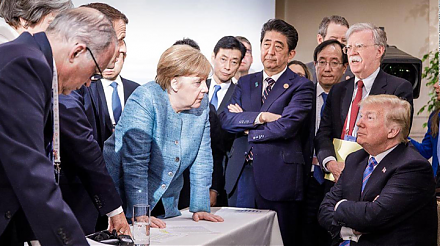
The finance ministers of Britain, Canada, France, Germany, Italy, and Japan team up against U.S. President Donald Trump and Treasury Secretary Steven Mnuchi
2018-01-04 07:36:00 Thursday ET

The world now faces an economic inequality crisis with few policy options. Some recent U.S. Federal Reserve data suggest that both income and wealth inequal
2019-04-27 16:41:00 Saturday ET

Tony Robbins suggests that one has to be able to make money during sleep hours in order to reach financial freedom. Most of our jobs and life experiences tr
2021-11-22 11:29:00 Monday ET

U.S. judiciary subcommittee delves into the market dominance of online platforms in terms of the antitrust, commercial, and administrative law in America.
2018-09-17 12:40:00 Monday ET

Nobel Laureate Robert Shiller's long-term stock market indicator points to a recent peak. His cyclically-adjusted P/E ratio (or CAPE) accounts for long-